Lori Lundin; Scott Walterman : Voice of America (VOA)
| Total Responses: | 3 |
| Average Quality Score: | 64.0 |
| Average Bias Score: | 3.7 |
| gen: 2026/07/24:13:07 in 1 min 29.7 sec (old)bias: 3 (Center) |
| type: newsquality: 74 |
| pts: 0 |

 | author: | Lori Lundin; Scott Walterman | institution: | Voice of America (VOA) | ¿porque no los dos? |
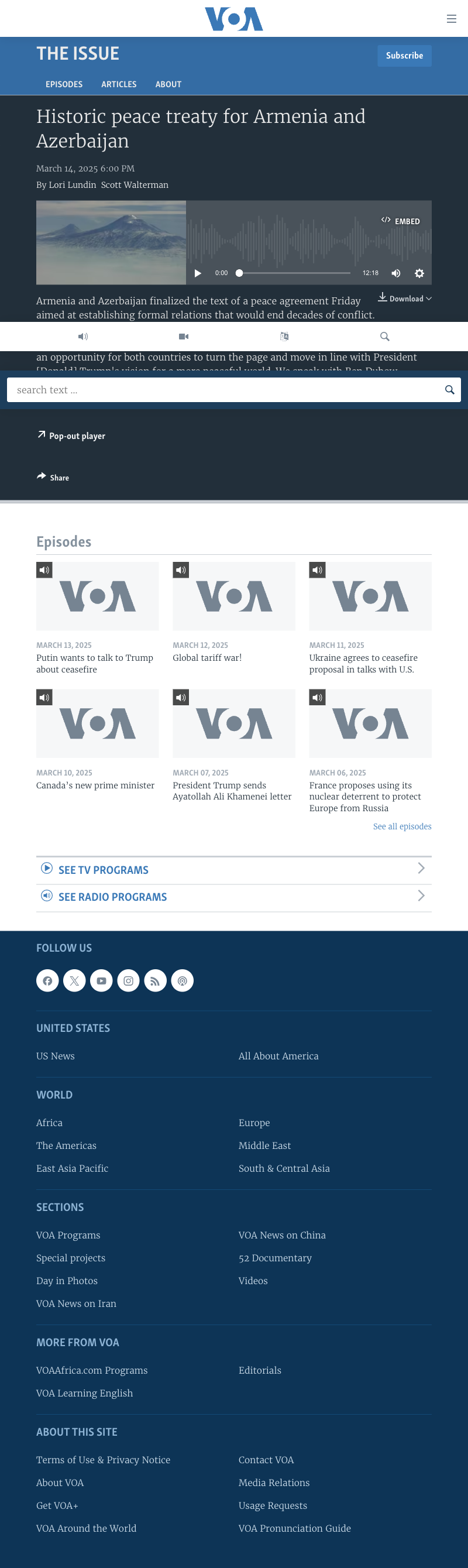
| tl;dr | A Voice of America “The Issue” segment titled “Historic peace treaty for Armenia and Azerbaijan” (March 14, 2025) reports that Armenia and Azerbaijan finalized the text of a peace agreement intended to establish formal relations and end decades of conflict. The piece is framed as a major, positive diplomatic development and appears presented in an audio/news-program format. | ||||
| deeper: | Content/frame: The headline’s use of “Historic” signals an upbeat, significance-boosting frame before the audience hears the evidence. The brief visible teaser text emphasizes the peace agreement as a pathway to ending a long conflict—constructive, diplomacy-forward framing. Balance/omissions (based on what’s visible in the screenshot): The page view does not show detailed sourcing, countervailing perspectives, or specific points of contention (e.g., enforcement mechanisms, border delimitation, security guarantees, prisoners, displaced persons/return, or international monitoring). Without those elements visible, the piece risks simplifying a complex conflict into a “deal reached = problem solved” narrative. Bias assessment: The likely bias here is mild pro-agreement / pro-normalization optimism rather than partisan politics—subtle agenda-setting through word choice (“historic”) and emphasis on conflict resolution. No overt demonization of a side is apparent in the visible text. Quality assessment: Presentation is professional (clear headline, bylines, date/time, audio segment with download/embed). However, from the portion visible, the article page does not demonstrate deep evidentiary support (documents linked, direct quotations from both governments, independent analysts, or affected communities). If the audio includes those, quality would rate higher; as displayed, it’s solid but not richly substantiated. | ||||
media: | |||||
| gen: 2026/07/22:05:10 in 1 min 37.1 sec (old)bias: 4 (Center-Right) |
| type: lolsquality: 60 |
| pts: 0 |
 | author: | Lori Lundin; Scott Walterman | institution: | Voice of America (VOA) | ¿porque no los dos? |
| tl;dr | The page presents a VOA audio segment titled “Historic peace treaty for Armenia and Azerbaijan,” dated March 14, 2025. The lede says the two countries finalized the text of a peace agreement aimed at formal relations and ending decades of conflict. The brief visible copy frames the deal as an opportunity to “turn the page” and explicitly links it to President Trump’s vision for a more peaceful world. No concrete treaty provisions, verification mechanisms, or reactions from both sides are provided in the visible text. | ||||
| deeper: | The framing leans favorable to the sitting U.S. president by crediting the agreement to his “vision,” which nudges the piece toward a pro-administration slant. It lacks balancing language, independent sourcing, or critical context such as who mediated, what concessions were made, how Nagorno-Karabakh’s status and displaced populations are addressed, security guarantees, border demarcation steps, and enforcement or timelines. The item appears to be a short program blurb with an audio clip; as text, it is thin on facts, quotes, and documentation. Quality would improve with treaty details, statements from Armenian and Azerbaijani officials and opposition voices, independent experts, and regional implications involving Russia, Turkey, and the EU. | ||||
media: | |||||
| gen: 2026/07/18:02:14 in 1 min 8.6 sec (old)bias: 4 (Center) |
| type: newsquality: 58 |
| pts: 0 |

 | author: | Lori Lundin; Scott Walterman | institution: | Voice of America (VOA) | ¿porque no los dos? |
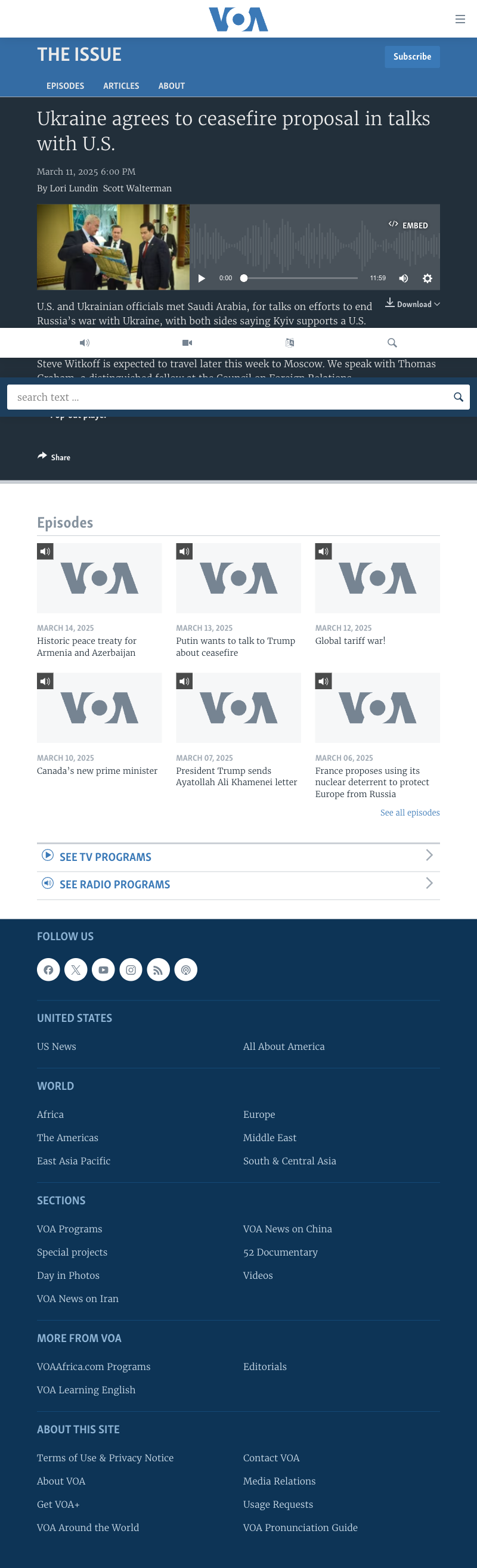
| tl;dr | A VOA program page says Ukraine has agreed to a U.S.-backed ceasefire proposal following talks with the United States, reportedly held in Saudi Arabia. The page trails an audio segment featuring discussion of upcoming Moscow travel by a U.S. figure and commentary from a Council on Foreign Relations fellow. It links to related episodes on recent geopolitics. | ||||
| deeper: | The headline and blurb present a straightforward claim about a Ukraine ceasefire proposal without overtly loaded language, suggesting mild bias at most. However, the write‑up contains editing errors and an incomplete sentence (“met Saudi Arabia… with both sides saying Kyiv supports a U.S.”), which undermines clarity and precision. The piece relies on an audio segment for substance; the on‑page text offers little sourcing or detail about terms of the proposal, verification from Ukrainian officials, Russian reaction, or mediation context. Mentioning a think‑tank guest is standard but no competing viewpoints are summarized in text. Overall, middling quality due to sparse information and copy issues; neutrality appears intended but evidence and context are thin. | ||||
media: | |||||
You made it to the bottom. Now dance!


owned and operated by: RPN Omnigalactic Insitutution as of: 2026/10/16: 15:20 in 0 ms
Enter Code
Login with Account